















Decentralized finance (DeFi) continues to expand beyond simple lending and trading – and at the heart of this evolution lies Chainlink (LINK), the decentralized oracle network that securely connects blockchains to external data and services. What began as a solution to the blockchain “oracle problem” has become a foundational layer powering the next generation of financial innovation.
Oracles: The Backbone of DeFi’s Growth
Blockchains are isolated environments. They can store and execute smart contracts but can’t inherently access real‑world information like asset prices, interest rates, or economic indicators. Chainlink’s decentralized oracles provide that secure bridge by aggregating data from multiple premium sources and delivering it on‑chain in tamper‑proof form – a capability that enabled the first wave of DeFi innovation such as borrowing, lending, and decentralized exchanges.
Over time, Chainlink price feeds have become the industry standard for DeFi applications. These feeds power critical protocol operations like collateral valuation, liquidation triggers, stablecoin pegs, and margin calculations – ensuring that decentralized platforms operate with real‑time, secure data.
A Broader, Full‑Stack Infrastructure for on‑Chain Finance
Chainlink’s evolution hasn’t stopped at price feeds. According to recent analysis, the network has matured into a full‑stack institutional platform that supports data, interoperability, compliance, privacy, and orchestration capabilities for onchain finance. This shift positions Chainlink to serve not just DeFi primitives but complex financial ecosystems involving tokenized assets, real‑world integrations, and cross‑chain workflows.
For example, advanced tools like the Cross‑Chain Interoperability Protocol (CCIP) help move assets and data securely between different blockchains – a crucial capability as DeFi expands across ecosystems like Ethereum, Base, Solana, and others.
Real‑World Adoption and Partnerships: DeFi Meets TradFi
Chainlink’s role in bridging decentralized finance with traditional financial systems has gained momentum through strategic partnerships. A notable example is collaboration with Mastercard to enable billions of payment cardholders to buy crypto directly on‑chain, a move that integrates payment rails with DeFi infrastructure and broadens access to blockchain finance.
Similarly, projects joining Chainlink Build – an ecosystem support program – demonstrate how emerging DeFi protocols (including AI‑driven vaults like Demether) are leveraging Chainlink’s oracle services for secure pricing, automation, and risk management.
These developments underline a broader trend: DeFi is no longer an isolated crypto experiment – it’s interfacing with global financial systems.

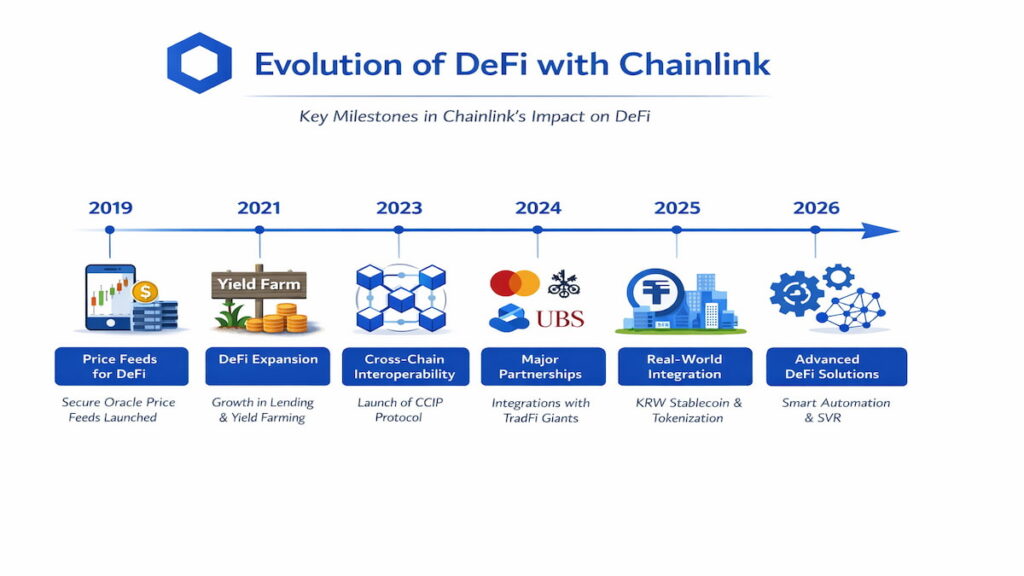
Growing Economic Footprint in Decentralized finance
Chainlink’s impact on DeFi can be measured not only by usage but by total value secured (TVS), a metric representing the amount of economic activity relying on Chainlink oracles. As of recent reports, this figure has surged to record highs, with tens of billions of dollars of assets and contracts secured across hundreds of protocols.
This growth reflects a positive feedback loop: the more DeFi protocols depend on Chainlink for security and data integrity, the more valuable and reliable the oracle network becomes – which in turn encourages further adoption.
New Financial Primitive Innovations – Beyond DeFi 1.0
The next evolution of DeFi – sometimes called DeFi 2.0 – focuses on solving deeper systemic challenges such as protocol efficiency, liquidity lockups, and composability. In this context, Chainlink’s services (including automation tools and verifiable randomness) provide essential primitives for more advanced financial products like automated rebalancing, limit orders, synthetic assets, and dynamic yield strategies.
Chainlink’s Smart Value Recapture (SVR) initiative, for instance, introduces a mechanism for capturing and sharing MEV (miner or max extractable value) revenue between protocols and the oracle network – creating more sustainable economic models for DeFi.
Conclusion: Chainlink’s Role in the Future of DeFi
DeFi is evolving from simple decentralized lending markets to a comprehensive financial infrastructure that integrates off‑chain data, institutional capital, cross‑chain assets, and real‑world use cases. Chainlink has emerged as a keystone technology in this evolution, providing the secure, decentralized data and interoperability fabric that enables these advancements.
Whether supporting stablecoins, powering AI‑driven DeFi strategies, or bridging TradFi payment systems with blockchain rails, Chainlink is at the forefront of DeFi’s transformation into a mature, global financial system – a shift that will shape how markets operate in the years to come.