












Introduction
Forex trading can be volatile and intimidating for beginners and seasoned traders alike. One strategy that has proven effective in other markets, like stocks and cryptocurrencies, is Dollar-Cost Averaging (DCA). DCA helps traders reduce emotional decision-making, manage risk, and smooth out entry points over time. This article explores DCA in the context of forex trading, its advantages, challenges, and how to implement it effectively.
What is Dollar-Cost Averaging (DCA)?
Dollar-Cost Averaging is an investment strategy where a trader invests a fixed amount of money at regular intervals, regardless of market conditions. The idea is simple:
- When the currency pair is strong, your fixed investment buys fewer units.
- When the pair is weak, the same investment buys more units.
- Over time, your average entry price becomes more stable, reducing the risk of investing all at once during a volatile spike or drop.
How Dollar-Cost Averaging Works in Forex
Unlike stocks, forex trading involves high leverage, tight spreads, and rapid price fluctuations. Implementing DCA in forex requires careful planning:
- Select a currency pair: Common choices include EUR/USD, GBP/USD, or USD/JPY.
- Decide your fixed investment: Determine a consistent amount to invest per interval.
- Set your interval: Daily, weekly, or monthly investments depending on your trading style.
- Monitor positions: Adjust exposure according to leverage and margin requirements.
Example:
- You invest $500 weekly in EUR/USD.
- Week 1: EUR/USD at 1.100 → $500 buys 454.55 EUR
- Week 2: EUR/USD at 1.050 → $500 buys 476.19 EUR
- Week 3: EUR/USD at 1.080 → $500 buys 462.96 EUR
Your average cost per EUR becomes smoother than trying to time a single “perfect” purchase.
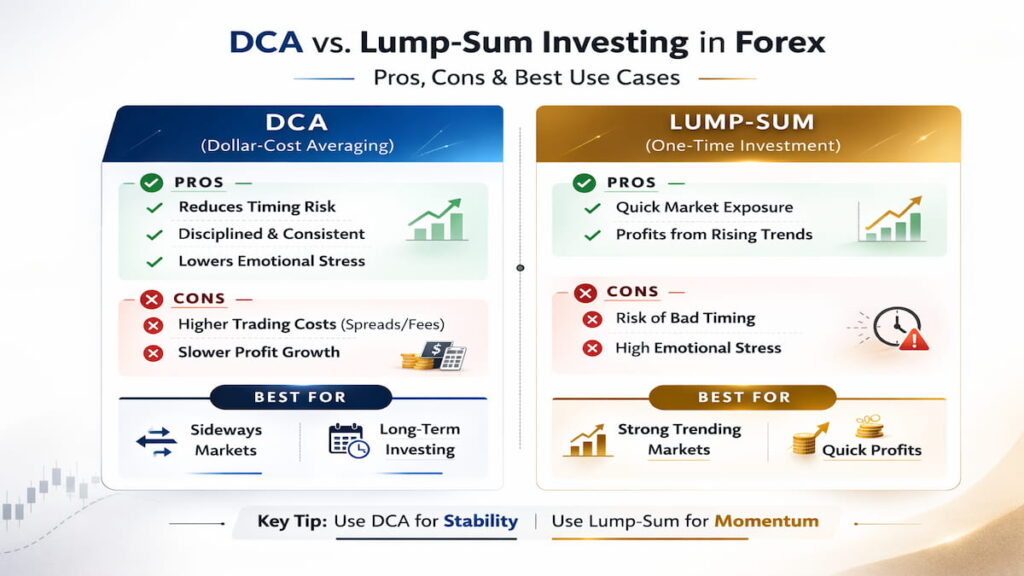
Pros of Using DCA in Forex
- Reduces timing risk: Avoids investing all capital at the wrong moment in volatile markets.
- Disciplined approach: Encourages consistent investing rather than emotional trades.
- Smooths average entry price: Mitigates the impact of short-term volatility.
- Lower stress: Traders are less tempted to panic during sudden price swings.
Cons of Using Dollar-Cost Averaging in Forex
- Spreads and fees: Frequent trades incur more broker costs, which can reduce profits.
- Leverage risk: High leverage can amplify losses if the trend moves strongly against you.
- Trending markets: In a persistent downtrend, DCA may increase exposure to losing positions.
- Not a get-rich-quick strategy: Best for long-term accumulation rather than short-term speculation.
Tips for Implementing DCA in Forex
- Use low-leverage accounts to avoid margin calls when averaging down.
- Choose stable currency pairs to minimize extreme volatility.
- Automate your investments using trading platforms or brokers that allow recurring purchases.
- Combine DCA with risk management like stop-losses and position size limits.

FAQs About DCA in Forex
Q1: Can beginners use DCA in forex?
Yes, it’s particularly useful for beginners because it reduces the pressure of timing the market.
Q2: How often should I invest using DCA?
It depends on your trading goals, but weekly or monthly intervals are common.
Q3: Does DCA guarantee profits in forex?
No, DCA reduces risk and smooths entry price, but forex markets are inherently risky and can still result in losses.
Q4: Is DCA better than trading based on signals or technical analysis?
DCA complements technical strategies but doesn’t replace them. For trend trading, technical signals may provide better timing.
Q5: Can I use DCA with leveraged accounts?
Yes, but extreme caution is needed. Leverage magnifies both gains and losses, so proper risk management is crucial.
Conclusion
Dollar-Cost Averaging in forex is a discipline-based strategy that helps manage risk and smooth out market volatility. While it’s not a “magic” solution for profits, combining DCA with solid risk management, low-leverage trading, and patience can provide a safer, more consistent approach to forex investing.
For traders willing to stick to a disciplined plan, DCA can be a powerful tool in the often chaotic forex market.