









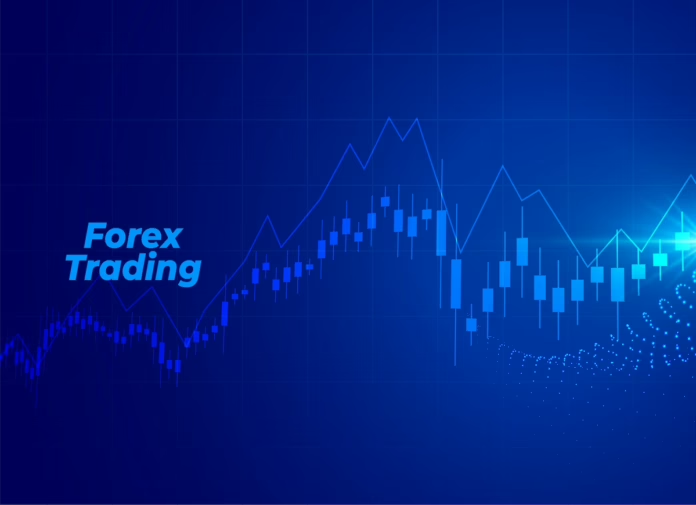
The foreign exchange market – commonly known as forex or FX – is the largest and most liquid financial market globally. Its size and dominance are not accidental; they stem from its fundamental role in the global economy, its decentralized structure, and the sheer scale of participation from institutions, governments, and individuals.
The Foundation of Global Commerce
At its core, the forex market exists to facilitate international trade and investment. Whenever goods, services, or capital move across borders, currencies must be exchanged. For example, when a European company imports products from the United States, it must convert euros into U.S. dollars. This constant need for currency conversion creates a continuous and unavoidable demand for forex transactions, making the market indispensable to global economic activity.
Unmatched Trading Volume
One of the most striking features of the forex market is its enormous daily trading volume. According to the Bank for International Settlements, forex trading exceeds $7 trillion per day. This figure far surpasses the daily volumes of stock markets and even the rapidly growing cryptocurrency sector. Such scale ensures that forex remains the most active financial marketplace in the world.
A 24 – Hour Global Market
Unlike traditional stock exchanges that operate within fixed hours, the forex market runs 24 hours a day, five days a week. This continuous operation is made possible by the rotation of major financial centers across different time zones – starting in Asia, moving to Europe, and then to North America. As one market closes, another opens, ensuring uninterrupted trading and constant liquidity.
Decentralized Structure
Forex operates as an over the counter (OTC) market, meaning there is no single centralized exchange. Instead, transactions occur through a global network of banks, financial institutions, brokers, and electronic trading platforms. This decentralized nature allows participants from anywhere in the world to engage in trading, significantly expanding the market’s reach and size.
Exceptional Liquidity
Liquidity refers to how easily assets can be bought or sold without significantly affecting their price. The forex market is the most liquid market in existence due to:
- The vast number of participants
- The high volume of transactions
- The constant demand for major currencies like the U.S. dollar, euro, and Japanese yen
High liquidity reduces transaction costs and allows for efficient price discovery, attracting even more participants and reinforcing the market’s dominance.
Diverse Market Participants
Another reason for the forex’s size is the diversity of its participants. These include:
- Central banks managing monetary policy
- Commercial banks facilitating transactions
- Multinational corporations hedging currency risk
- Hedge funds and institutional investors seeking profit
- Retail traders speculating on price movements
This wide range of participants ensures that the market is active for multiple reasons – not just speculation.
The Role of Brokers Like LMFX
Retail traders typically access the forex market through online brokers, and platforms like LMFX play an important role in this ecosystem. LMFX is a global forex and CFD broker that offers trading access to currencies, commodities, indices, and other instruments through platforms such as MetaTrader 4.
It provides features such as high leverage (up to 1:1000), multiple account types, and tools like economic calendars and market analysis, which are designed to support different trading strategies.
However, it is important to note that LMFX operates without regulation from major financial authorities, which means traders should carefully assess risks before using such platforms.
Multiple Functions Beyond Trading
Forex is not solely a speculative marketplace. It plays several critical roles:
- Hedging: Companies protect themselves against currency fluctuations
- Policy implementation: Central banks influence exchange rates
- Global payments: Facilitates international transactions
- Investment flows: Supports cross – border capital movement
Because it serves so many essential functions, the market remains consistently active and expansive.
Conclusion
The forex market’s status as the largest financial market in the world is the result of its central role in global economic activity, its massive trading volume, continuous operation, and broad participation. It is not just another market – it is the backbone of international finance, enabling the smooth functioning of the global economy.