













Financial markets are full of opportunities – and risks. Every investor or trader approaches the markets with a different goal. Some aim to protect their assets and minimize losses, while others are focused on profit from price movements. Understanding hedging vs speculation is critical for anyone looking to trade smarter, whether in Forex, stocks, commodities, or crypto.
What Is Hedging in Finance?
Hedging is a risk management strategy used to protect your investments or business from market volatility. Unlike speculation, hedging is not about chasing profits; it’s about reducing potential losses and ensuring stability.
Practical Example:
A European company expecting payment in US dollars in three months faces the risk that the dollar could weaken against the euro. By using a forward contract or a currency option, the company can lock in a rate today and eliminate the risk of exchange rate losses.
Other hedging examples:
- Investors holding stocks may use options to protect against sudden market drops.
- Commodity producers, like farmers or miners, hedge future output prices using futures contracts.
- Interest rate hedging can protect borrowers from rising loan costs.
Key features of hedging:
- Goal: Protect existing assets from adverse price movements
- Users: Corporations, institutional investors, conservative traders
- Risk: Low to moderate
- Focus: Stability over profit
Why it matters: Hedging helps preserve capital, manage cash flow, and provides confidence in uncertain markets. It’s especially important for businesses and investors who cannot afford large swings in their income or portfolio.
What Is Speculation in Finance?
Speculation is the opposite of hedging: it involves taking calculated risks to profit from market movements. Speculators don’t necessarily have underlying exposure – they bet on the direction of prices in assets like stocks, Forex, commodities, or cryptocurrencies.
Practical Example:
A trader buys Bitcoin expecting a price surge over the next week. If the price rises, they make a profit. If it drops, they face losses. Speculation is inherently risky but can offer significant returns if timed correctly.
Other speculative activities:
- Day trading stocks or Forex pairs
- Trading options or futures purely for price movements
- Investing in volatile assets like cryptocurrencies for short – term gains
Key features of speculation:
- Goal: Profit from price changes
- Users: Hedge funds, day traders, risk – tolerant investors
- Risk: High
- Focus: Maximizing returns
Why it matters: Speculation drives liquidity in markets, helps with price discovery, and provides opportunities for profit – but it requires knowledge, timing, and discipline.
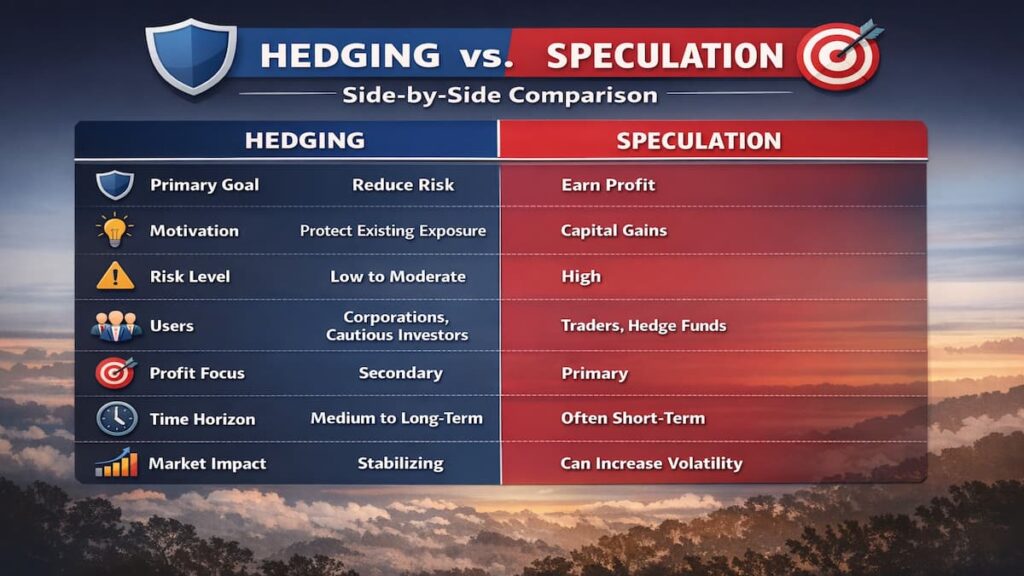
Hedging vs. Speculation: Side – by – Side Comparison
Same Tools, Different Purposes
Interestingly, financial instruments like futures, options, and swaps can be used for both hedging and speculation. The distinction lies not in the instrument but in the intent behind using it.
Example:
- A wheat farmer uses a futures contract to lock in a price for next season’s crop → hedging.
- A trader buys the same futures contract hoping the price will rise → speculation.
This shows how versatile financial instruments are, and why understanding your strategy and goal is crucial.
Choosing the Right Approach
Deciding between hedging and speculation depends on:
- Your risk tolerance: Can you afford potential losses, or do you need protection?
- Your financial goals: Are you trying to preserve capital or maximize profit?
- Your market knowledge: Hedging can be straightforward; speculation requires careful analysis.
- The market environment: Volatile markets may require more hedging, while trending markets can offer speculative opportunities.
Final Thoughts on Hedging vs. Speculation
Both hedging and speculation are essential components of financial markets. Hedging prioritizes stability, providing a safety net for investors and businesses. Speculation focuses on opportunity, allowing traders to capitalize on price movements.
Smart traders understand when to hedge and when to speculate. By clearly defining goals, assessing risk tolerance, and choosing the right instruments, you can navigate markets with confidence – protecting your investments while seeking potential profits.
Whether you’re trading Forex, stocks, crypto, or commodities, mastering the difference between hedging and speculation is key to long – term success.