













Artificial intelligence and blockchain are two of the most transformative technologies of the last decade. While AI is reshaping automation, creativity, and decision-making, blockchain is redefining ownership, trust, and digital value. When these two fields intersect, a new concept emerges: tokenized AI models.
Tokenized AI models aim to turn artificial intelligence systems into programmable, ownable, and economically participatory assets using crypto infrastructure. This fusion has the potential to change how AI is funded, governed, accessed, and monetized.
What Are Tokenized AI Models?
A tokenized AI model is an artificial intelligence system whose access, governance, or economic value is linked to blockchain-based tokens.
Tokenization can apply to AI in several ways:
- Access tokens: Users must hold a token to use the model.
- Revenue-sharing tokens: Token holders earn a portion of the model’s usage revenue.
- Governance tokens: Token holders vote on model updates or policy decisions.
- Ownership tokens (fractionalization): The model itself is treated as a digital asset divided among stakeholders.
Instead of AI being owned solely by a centralized corporation, tokenization allows distributed ownership and economic participation.
Why Tokenized AI?
1. Decentralized Ownership
Today, most powerful AI models are owned by large tech companies. Tokenization creates the possibility for community-owned AI systems. Contributors – whether developers, data providers, or compute suppliers – could receive tokens representing their stake in the network.
This mirrors the way decentralized networks like Ethereum distribute value among validators, developers, and users.
2. Incentivized Data and Compute
AI models require massive amounts of:
- Data
- Compute power
- Human feedback
- Ongoing fine-tuning
Tokenized systems can reward participants who provide these resources. For example:
- Data contributors could earn tokens.
- Compute providers could be paid in crypto.
- Validators could verify model outputs.
Projects such as Bittensor experiment with incentivizing decentralized AI training and evaluation through token rewards.
3. Open Access and Micropayments
Traditional AI APIs operate on centralized billing systems. Blockchain enables:
- Borderless micropayments
- Permissionless access
- Smart contract-based pricing models
Users could pay per query using tokens without needing traditional banking infrastructure. This lowers barriers to entry for developers globally.
4. Governance and Transparency
AI governance is becoming a global concern. Who decides how a model behaves? How are biases handled? Who controls updates?
Tokenized governance systems allow communities to vote on:
- Model parameter updates
- Content moderation rules
- Safety thresholds
- Revenue allocation
While not perfect, this approach introduces transparency into decision-making processes.
How Tokenized AI Models Work (Technically)
A tokenized AI model typically combines:
- Off-chain computation: The AI model runs on traditional servers or decentralized compute networks.
- On-chain coordination: Smart contracts handle payments, rewards, and governance.
- Token economics: Incentive structures align contributors and users.
The blockchain does not usually store the entire AI model (due to size and cost constraints). Instead, it manages economic logic while the model operates off-chain.
Some decentralized storage networks such as Filecoin can host datasets or model checkpoints, adding resilience.
Emerging Real-World Examples
Several projects are exploring tokenized AI:
- Bittensor: A decentralized machine learning network that rewards contributors based on the quality of model outputs.
- Fetch.ai: Combines AI agents with blockchain for autonomous economic activity.
- SingularityNET: A decentralized marketplace for AI services.
These projects attempt to move AI development from centralized labs to distributed ecosystems.
Economic Implications
Tokenized AI models introduce a new economic category: AI as a yield-generating asset.
Instead of simply using AI, individuals can invest in AI networks. Token holders may benefit from:
- Increased demand for model usage
- Network growth
- Governance influence
- Revenue-sharing mechanisms
However, this also introduces speculative risks. Token prices may detach from actual model utility, leading to bubbles.
Challenges and Risks
Despite the promise, tokenized AI faces serious hurdles:
1. Scalability
AI training requires enormous compute resources. Fully decentralized training is still technically difficult.
2. Quality Control
Open participation may introduce low-quality data or malicious inputs.
3. Regulation
If AI tokens represent revenue-sharing rights, they may fall under securities regulations in some jurisdictions.
4. Security
Smart contract vulnerabilities can expose financial risks.
5. Incentive Design
Poor tokenomics can destabilize networks if rewards are not aligned with long-term utility.
Artificial intelligence and blockchain are two of the most transformative technologies of the last decade. While AI is reshaping automation, creativity, and decision-making, blockchain is redefining ownership, trust, and digital value. When these two fields intersect, a new concept emerges: tokenized AI models.
Tokenized AI models aim to turn artificial intelligence systems into programmable, ownable, and economically participatory assets using crypto infrastructure. This fusion has the potential to change how AI is funded, governed, accessed, and monetized.
What Are Tokenized AI Models?
A tokenized AI model is an artificial intelligence system whose access, governance, or economic value is linked to blockchain-based tokens.
Tokenization can apply to AI in several ways:
- Access tokens: Users must hold a token to use the model.
- Revenue-sharing tokens: Token holders earn a portion of the model’s usage revenue.
- Governance tokens: Token holders vote on model updates or policy decisions.
- Ownership tokens (fractionalization): The model itself is treated as a digital asset divided among stakeholders.
Instead of AI being owned solely by a centralized corporation, tokenization allows distributed ownership and economic participation.
Why Tokenized AI?
1. Decentralized Ownership
Today, most powerful AI models are owned by large tech companies. Tokenization creates the possibility for community-owned AI systems. Contributors – whether developers, data providers, or compute suppliers – could receive tokens representing their stake in the network.
This mirrors the way decentralized networks like Ethereum distribute value among validators, developers, and users.
2. Incentivized Data and Compute
AI models require massive amounts of:
- Data
- Compute power
- Human feedback
- Ongoing fine-tuning
Tokenized systems can reward participants who provide these resources. For example:
- Data contributors could earn tokens.
- Compute providers could be paid in crypto.
- Validators could verify model outputs.
Projects such as Bittensor experiment with incentivizing decentralized AI training and evaluation through token rewards.
3. Open Access and Micropayments
Traditional AI APIs operate on centralized billing systems. Blockchain enables:
- Borderless micropayments
- Permissionless access
- Smart contract-based pricing models
Users could pay per query using tokens without needing traditional banking infrastructure. This lowers barriers to entry for developers globally.
4. Governance and Transparency
AI governance is becoming a global concern. Who decides how a model behaves? How are biases handled? Who controls updates?
Tokenized governance systems allow communities to vote on:
- Model parameter updates
- Content moderation rules
- Safety thresholds
- Revenue allocation
While not perfect, this approach introduces transparency into decision-making processes.
How Tokenized AI Models Work (Technically)
A tokenized AI model typically combines:
- Off-chain computation: The AI model runs on traditional servers or decentralized compute networks.
- On-chain coordination: Smart contracts handle payments, rewards, and governance.
- Token economics: Incentive structures align contributors and users.
The blockchain does not usually store the entire AI model (due to size and cost constraints). Instead, it manages economic logic while the model operates off-chain.
Some decentralized storage networks such as Filecoin can host datasets or model checkpoints, adding resilience.
Emerging Real-World Examples
Several projects are exploring tokenized AI:
- Bittensor: A decentralized machine learning network that rewards contributors based on the quality of model outputs.
- Fetch.ai: Combines AI agents with blockchain for autonomous economic activity.
- SingularityNET: A decentralized marketplace for AI services.
These projects attempt to move AI development from centralized labs to distributed ecosystems.
Economic Implications
Tokenized AI models introduce a new economic category: AI as a yield-generating asset.
Instead of simply using AI, individuals can invest in AI networks. Token holders may benefit from:
- Increased demand for model usage
- Network growth
- Governance influence
- Revenue-sharing mechanisms
However, this also introduces speculative risks. Token prices may detach from actual model utility, leading to bubbles.
Challenges and Risks
Despite the promise, tokenized AI faces serious hurdles:
1. Scalability
AI training requires enormous compute resources. Fully decentralized training is still technically difficult.
2. Quality Control
Open participation may introduce low-quality data or malicious inputs.
3. Regulation
If AI tokens represent revenue-sharing rights, they may fall under securities regulations in some jurisdictions.
4. Security
Smart contract vulnerabilities can expose financial risks.
5. Incentive Design
Poor tokenomics can destabilize networks if rewards are not aligned with long-term utility.
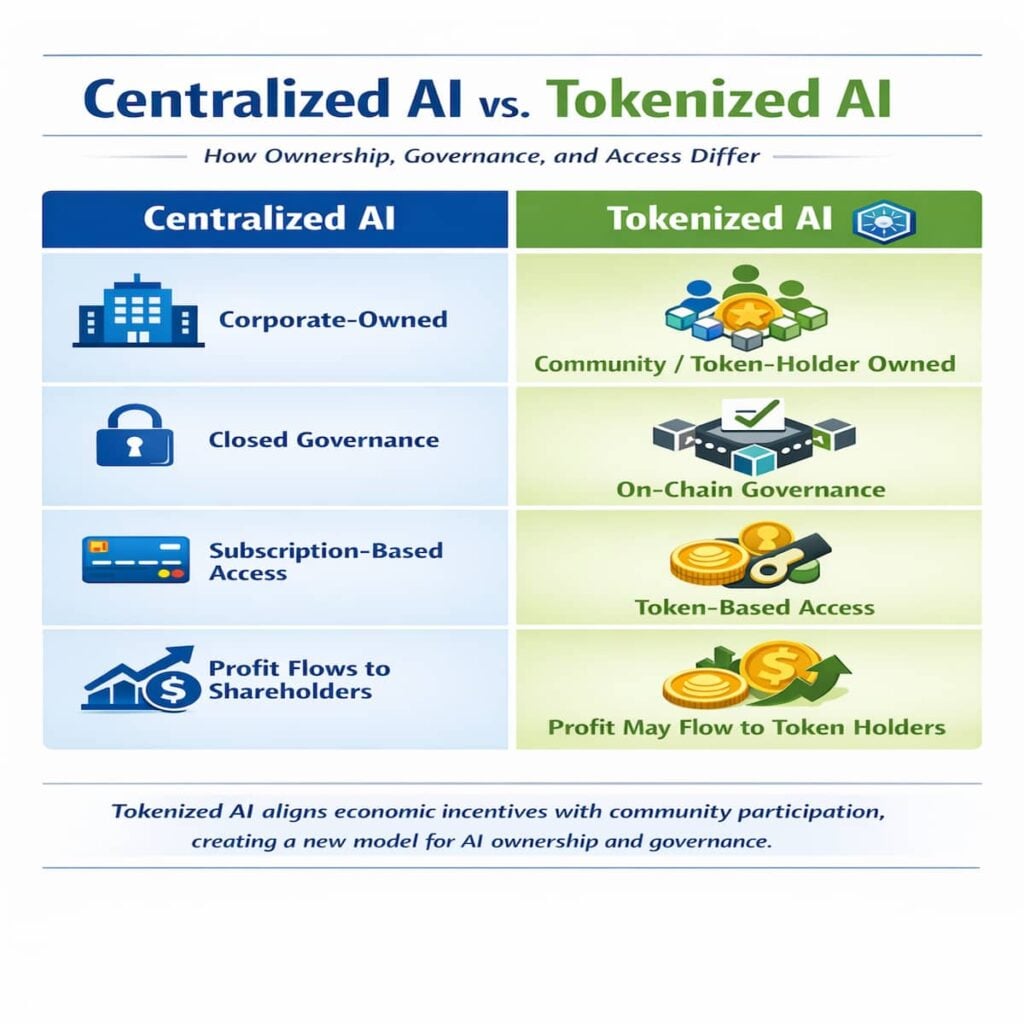
While centralized AI may remain dominant due to capital and infrastructure advantages, tokenized AI offers an alternative model for digital ownership and coordination.
The Long-Term Vision
The ultimate goal of tokenized AI is not just decentralization – it is economic alignment.
Imagine:
- AI systems owned by their users
- Models that pay contributors automatically
- Autonomous AI agents transacting using crypto
- Global access without centralized gatekeepers
In such a system, AI becomes a network rather than a product.
Blockchain provides the rails for ownership and coordination. AI provides the intelligence layer. Together, they form the foundation of programmable digital economies.
Conclusion
Tokenized AI models represent an early but rapidly evolving frontier at the intersection of artificial intelligence and cryptocurrency. By combining AI’s computational power with blockchain’s ownership and incentive mechanisms, developers are experimenting with new ways to build, fund, and govern intelligent systems.
Whether tokenized AI will rival centralized labs remains uncertain. But the concept signals a broader shift: technology is moving toward systems where intelligence, ownership, and economic participation are increasingly intertwined.
As AI becomes more powerful, questions of control and value distribution become more urgent. Tokenization offers one possible answer – not just to who uses AI, but to who owns it.