










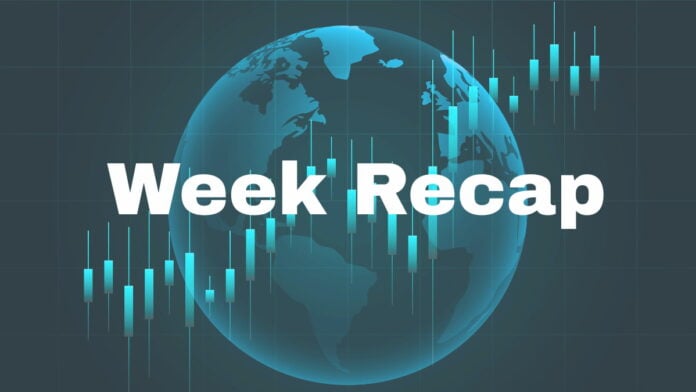
A wild week for the markets: GDP slows to 1.4%, the “New Tariff Regime” begins, and Bitcoin fights back. Dive into our deep-dive analysis of the week’s winners and losers.
The final week of February 2026 will be remembered as a pivot point for U.S. trade policy and a test of resilience for global markets. Following a seismic Supreme Court ruling that dismantled the administration’s primary tariff framework, a “New Tariff Regime” was born overnight, sending ripples through equity, commodity, and crypto markets.
1. The Judicial Reset: SCOTUS v. The Executive
The week opened in the shadow of the Supreme Court’s 6 – 3 decision in Learning Resources, Inc. v. Trump. The Court ruled that the International Emergency Economic Powers Act (IEEPA) does not grant the President the authority to impose broad – based revenue – raising tariffs – a power reserved exclusively for Congress under the Taxing Clause.
- The Fallout: The ruling invalidated roughly $130 – $142 billion in tariffs collected throughout 2025. While importers are already eyeing massive refunds, the administration responded within 24 hours.
- The Pivot: Invoking Section 122 of the Trade Act of 1974, the President implemented a temporary (150 – day) 10% uniform import duty effective February 24. By the weekend, social media posts from the White House suggested this could be bumped to 15%, the maximum allowed under that specific statute.
- The Exception: Sector – specific tariffs on steel, aluminum, and semiconductors remain in place, as they were enacted under Section 232 and remain unaffected by the SCOTUS ruling.
2. Inflation & Macro: The Growth Dilemma
While trade headlines dominated, the underlying economic data painted a picture of a cooling engine.
- GDP Deceleration: Revised Q4 2025 data showed the U.S. economy expanded at a modest 1.4%, down from 4.4% in Q3. Analysts largely blame the recent federal government shutdown for shaving more than a full percentage point off growth.
- PCE Inflation: The January Core PCE Price Index – the Fed’s preferred gauge – came in at 3.0% year – over – year. While CPI showed a slight deceleration to 2.4%, the “sticky” nature of core prices suggests that the Fed’s target of 2% remains elusive, likely pushing any hopes of interest rate cuts further into the second half of the year.
- Industrial Resurgence: A bright spot appeared in Industrial Production, which rose 0.7% in January, led by a 0.6% surge in manufacturing – the strongest gain in nearly a year.
3. Crypto: A “Relief Bounce” in a Bearish Winter
The crypto market, currently mired in a “Crypto Winter,” saw a rare flash of green this week.
- Price Action: After Bitcoin (BTC) dipped toward a yearly low of $62,900 early in the week, it reclaimed the $65,000 – $66,000 zone by Wednesday. Ethereum (ETH) followed suit, bouncing off an $1,826 floor to trade near $1,925.
- The Catalyst: Traders dubbed it the “TACO trade” (Trump Always Chickens Out), as the 10% tariff was lower than the 15% – 20% many had feared. This localized “risk – on” sentiment allowed Bitcoin to snap a losing streak, even as the broader year – to-date trend remains down 27%.
- Sentiment: Despite the bounce, the Fear & Greed Index remains at an “Extreme Fear” level of 11, with ETF outflows totaling nearly $4 billion over the last five weeks.
Market Summary Table
| Asset / Index | Weekly Performance | Key Narrative |
| S&P 500 | +1.08% | Led by “Real Economy” stocks (Caterpillar, Walmart). |
| Nasdaq | +1.51% | Recovery driven by relief over the tariff ruling. |
| Bitcoin (BTC) | +3.08% (24h) | Technical bounce after “Extreme Fear” lows. |
| Gold | ~$5,170/oz | Strong hedge against trade uncertainty and dollar fluctuations. |
| 10Y Treasury | 4.30% | Yields edged up as markets priced in “higher for longer” rates. |
Strategic Analysis: The “Two – Track” Recovery
We are witnessing a divergence in the “AI-driven” market. The explosive gains of 2025 are softening, and investors are rotating into “Real Economy” sectors – industrials, energy, and consumer defensives.
The SCOTUS ruling is a double – edged sword: while it provides a temporary fiscal impulse via potential tariff refunds (acting like a stimulus for importers), the replacement 10% – 15% duties under Section 122 will likely add 0.6% to the price level in the short run.
The Bottom Line
For the first time in years, the U.S. expansion is lagging behind the UK and Japan. Expect a volatile March as the market digests whether the new “Section 122” tariffs will be a temporary bridge or the start of a new, more protectionist era.