'/%3E%3C/svg%3E)
'/%3E%3Cpath%20fill='%23b2b2b2'%20d='M241%20382q0%2016%2017%2026%2017%2011%2042%2011t42-11q16-11%2017-26V269H241'/%3E%3Cpath%20fill='%239f7e00'%20d='M241%20379q0%2014%208%2023%209%209%2021%209%2014%200%2021-9%209-9%209-23V269h-59'/%3E%3Cpath%20d='M241%20339v-70h59v110q0%2014-9%2023l-6%205v-68h-15v72q-8%200-14-4v-68zm59%2040c0%2022%2015%2032%2029%2032%2021%200%2030-18%2030-32v-40h-59'/%3E%3Cpath%20fill='%239f7e00'%20d='M266%20277v5h2v12h-3v-5h2v-5h-9v5h2v5h-4v9h3v18h-5v10h34v-10h-5v-18h3v-9h-4v-5h2v-5h-9v5h2v5h-3v-12h2v-5zm42%20101q0%2010%206%2017%206%206%2015%207%2010-1%2016-7%206-7%206-17v-29h-43'/%3E%3Ccircle%20fill='%230044ad'%20cx='329.5'%20cy='372'%20r='6'/%3E%3Cellipse%20fill='%230044ad'%20cx='300'%20cy='340'%20rx='16'%20ry='21'/%3E%3C/svg%3E)
'/%3E%3C/g%3E%3Cuse%20href='%23c'%20transform='matrix(-1%200%200%201%20720%200)'/%3E%3C/svg%3E)













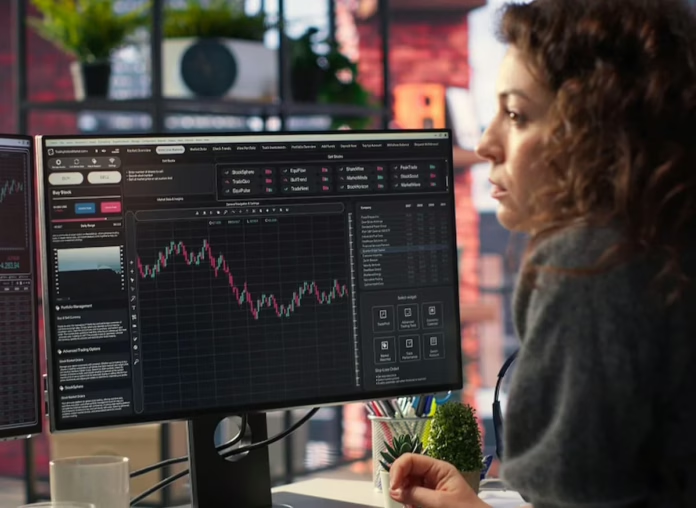
In forex trading, strategy and technical analysis are only part of the equation. The true differentiator between consistently profitable traders and those who struggle is trading psychology.
The forex market is fast-moving, highly liquid, and emotionally demanding. Traders must make decisions under uncertainty while managing risk and volatility. This makes psychological strength a critical component of long-term success.
What Is Forex Trading Psychology?
Forex trading psychology refers to the emotional and mental state that influences trading decisions. It includes how traders respond to:
- Profits and losses
- Market volatility
- Risk exposure
- Uncertainty and ambiguity
Even with a well-tested trading strategy, poor psychological control can lead to inconsistent execution and suboptimal results.
Why Psychology Matters in Forex Trading
Markets are driven by human behavior. As a result, traders are constantly exposed to emotional triggers such as fear, greed, and stress.
Key reasons psychology matters:
- Prevents impulsive decision-making
- Improves consistency in strategy execution
- Helps manage losses effectively
- Reduces overtrading and emotional trading
- Enhances long-term performance
Core Psychological Traits of Successful Forex Traders
1. Emotional Control
Emotions are one of the biggest challenges in trading.
- Fear may cause premature exits or missed opportunities
- Greed may lead to overleveraging or holding trades too long
Successful traders maintain emotional neutrality and treat trading as a probabilistic process rather than an emotional experience.
2. Discipline and Rule Adherence
Discipline is the ability to follow a trading plan without deviation.
This includes:
- Following entry and exit rules
- Respecting stop-loss levels
- Avoiding impulsive trades
- Sticking to predefined strategies
Consistency in execution is essential for evaluating and improving any trading system.
3. Risk Management Mindset
Professional traders prioritize risk over reward.
Key principles include:
- Limiting risk per trade
- Using appropriate position sizing
- Accepting that losses are part of trading
- Protecting capital as the primary objective
A strong risk mindset ensures survival in the market over the long term.
4. Patience and Selectivity
Not every market movement presents a valid opportunity.
Traders with strong psychology:
- Wait for high-probability setups
- Avoid overtrading
- Understand that inactivity can be a strategic decision
- Focus on quality rather than quantity of trades
Patience helps reduce unnecessary exposure to market noise.
5. Probability-Based Thinking
Forex trading is not about certainty—it is about probabilities.
- Each trade is part of a larger statistical sample
- Even profitable strategies include losing trades
- Success depends on long-term expectancy, not individual outcomes
Thinking in probabilities helps traders remain objective and detached from short-term results.
6. Managing Cognitive Biases
Traders often fall victim to cognitive biases, including:
- Confirmation bias: Seeking information that supports existing beliefs
- Loss aversion: Overreacting to losses more than gains
- Overconfidence: Taking excessive risk after winning streaks
- Recency bias: Overvaluing recent market behavior
Awareness of these biases improves decision-making quality.
7. Psychological Resilience
Drawdowns are inevitable in forex trading.
Resilient traders:
- Maintain confidence during losing periods
- Continue following their strategy
- Avoid abandoning systems prematurely
- Recover without emotional overreaction
Resilience is essential for sustaining performance through market cycles.
8. Consistency and Routine
A structured routine supports psychological stability.
Effective trading routines often include:
- Pre-market analysis
- Defined trading sessions
- Trade journaling
- Performance review and optimization
Consistency in habits leads to consistency in outcomes.
Common Psychological Mistakes in Forex Trading
Many traders fail not due to lack of knowledge, but due to psychological errors such as:
- Overtrading due to boredom or impatience
- Ignoring stop-loss orders
- Revenge trading after losses
- Risking too much on a single trade
- Switching strategies frequently after short-term losses
Avoiding these mistakes is critical for long-term success.
How Forex Brokers Can Support Better Trading Psychology
A reliable forex broker can indirectly support better psychology by providing:
- Transparent pricing and execution
- Stable trading platforms
- Risk management tools
- Educational resources and analytics
- Demo accounts for practice without financial risk
These tools help traders build confidence and develop disciplined habits in a controlled environment.
Conclusion
Forex trading psychology is a foundational element of trading success. While technical and fundamental analysis help identify opportunities, it is psychological discipline that determines how effectively those opportunities are executed.
Traders who develop emotional control, discipline, risk awareness, and probability-based thinking are better positioned to achieve consistency in the forex market.