













Bitcoin halving is one of the most anticipated events in the cryptocurrency world. Occurring roughly every four years, it reduces the reward miners receive for adding new blocks by 50%, directly affecting Bitcoin’s supply. Traditionally, halvings have been linked to rising prices, but recent unexpected market volatility has put this pattern into question. Understanding the mechanics of halving is crucial for investors, miners, and enthusiasts looking to navigate the current crypto landscape.
What is Bitcoin Halving?
Bitcoin halving is a pre-programmed event in the blockchain that cuts the block reward in half, occurring approximately every 210,000 blocks. Its main purpose is to control Bitcoin’s supply, ensuring that the total number of coins never exceeds 21 million.
By gradually reducing the number of new Bitcoins created, halving enforces scarcity, a trait often compared to gold. Like gold, Bitcoin has a finite supply, and halving slows issuance, supporting long-term value even as markets fluctuate.
How Bitcoin Mining and Rewards Work
Bitcoin mining uses specialized computers to solve complex mathematical problems that verify transactions on the blockchain. Miners are rewarded with:
- Newly Created Bitcoins (Block Reward): This is the primary incentive for mining and the way new coins enter circulation.
- Transaction Fees: Miners also earn fees from transactions included in each block, which vary with network activity.
During halving, only the newly minted Bitcoins are affected – the block of reward is cut in half. Transaction fees remain unchanged, and over time, they will play an increasingly important role in sustaining miner incentives and network security.
Historical Bitcoin Halvings
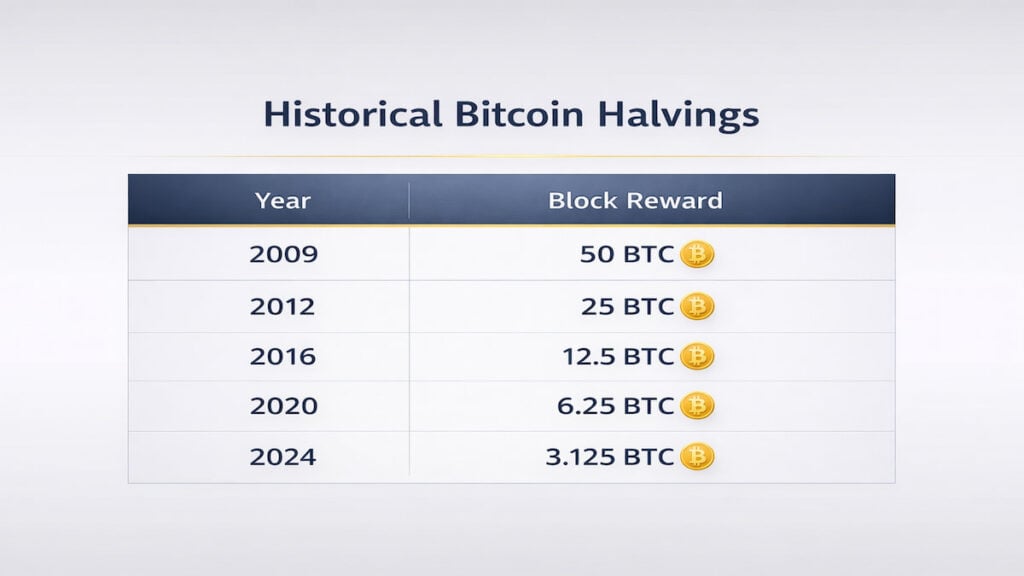
Each halving reduces the rate of new Bitcoin entering circulation, gradually creating scarcity. Historically, these events were followed by long – term price increases, though short – term market reactions varied.
Effects of Bitcoin Halving
1. Supply and Scarcity
Halving directly cuts the number of new coins entering the market, reinforcing Bitcoin’s deflationary design. Scarcity can create upward pressure on price if demand remains steady or grows, supporting the “digital gold” narrative.
2. Miner Incentives
Reduced rewards pressure miners to be more efficient. Less profitable operations may pause or shut down temporarily, but difficulty adjustments ensure network security is maintained.
3. Price Dynamics
Historically, halving events have preceded significant price rallies. Investors often anticipate scarcity, buying Bitcoin ahead of the halving. However, recent market conditions, including macroeconomic uncertainty and the unexpected fall of Bitcoin, show that halving alone does not guarantee immediate price increases.
4. Market Psychology
Halvings drive narrative and hype cycles, increasing volatility even before the reward reduction occurs. While anticipation can boost trading activity, recent Bitcoin drops suggest that broader market sentiment can outweigh halving optimism in the short term.
The Connection Between Bitcoin’s Recent Fall and the Upcoming Halving
Bitcoin’s recent unexpected decline challenges the usual halving narrative. While halvings historically have been associated with price surges, the current market shows that external factors – like macroeconomic pressure, institutional rotations, and leverage unwinds – can disrupt this pattern.
In other words:
- Short – term: The fall does not align with halving – driven scarcity expectations. Market volatility is dominating sentiment.
- Long – term: Halving still reduces supply over time. Once the market stabilizes, scarcity could resume its role in supporting prices.
Investors should view the fall as temporary turbulence, not a contradiction of the halving mechanism itself.
Why Bitcoin Halving Matters
Bitcoin halving is a cornerstone of its economic design:
- Controlled Supply: Reduces new coin creation, reinforcing scarcity.
- Miner Incentives: Tests miner efficiency and ensures network security.
- Market Psychology: Fuels anticipation and long – term investment.
- Long – Term Value: Maintains Bitcoin’s deflationary, store – value characteristics.
Even in a declining market, the halving event remains a key structural factor that shapes Bitcoin’s future.
Future of Bitcoin Halving
Halvings will continue roughly every four years until 2140, when all 21 million Bitcoins will be mined. At that point, miners will rely entirely on transaction fees for revenue.
Until then, halvings will remain central to Bitcoin’s scarcity model, influencing both market cycles and investor behavior. Each halving reinforces the network’s deflationary design, tests miner efficiency, and underpins the long – term value narrative – even amid short – term price volatility.
What to expect?
Bitcoin halving is more than a technical update – it’s a recurring economic event that affects supply, miner incentives, market psychology, and long – term value.
While the recent unexpected price drop shows that short – term movements can diverge from halving expectations, the mechanism itself continues to enforce scarcity and shape Bitcoin’s trajectory.
For investors, miners, and crypto enthusiasts, understanding halving is essential to navigating both the current market turbulence and the long-term Bitcoin ecosystem.