






Introduction: The Shift from Hype to Real Value
For years, Web3 has been associated with speculative assets like cryptocurrencies and NFTs. But a major shift is underway. Institutional investors are now focusing on real – world asset (RWA) tokenization, a sector that connects blockchain technology with tangible financial value.
This evolution marks a turning point – where Web3 is no longer just experimental but is becoming a core layer of modern financial infrastructure.
What Is Real World Asset Tokenization?
Real – world asset tokenization refers to the process of converting ownership rights of physical or traditional financial assets into blockchain – based tokens.
These assets include:
- Real estate
- Government bonds
- Commodities like gold
- Private credit and funds
Each token represents a fractional share of an underlying asset, enabling investors to trade, transfer, or hold ownership digitally.
Key Benefits
- Fractional ownership – Lower barriers to entry
- 24/7 trading – Unlike traditional markets
- Faster settlement – Minutes instead of days
- Global accessibility – Borderless investment opportunities
Why Institutions Are Investing in Tokenization
1. Unlocking Illiquid Assets
Traditional assets like real estate and private equity are notoriously illiquid. Tokenization transforms them into divisible, tradable units, unlocking trillions in dormant capital.
2. Massive Market Growth Potential
Industry projections suggest tokenized assets could reach trillions of dollars by 2030, making it one of the fastest – growing sectors in the blockchain.
This level of growth is attracting:
- Asset managers
- Banks
- Hedge funds
- Fintech platforms
3. Increased Efficiency and Cost Reduction
Blockchain – based systems streamline operations by removing intermediaries and automating processes through smart contracts.
This leads to:
- Lower administrative costs
- Real – time settlement
- Transparent ownership records
Real – World Use Cases of Tokenization
Tokenized Real Estate
Investors can now purchase fractional shares of properties, earning rental income without owning entire buildings.
Tokenized Bonds and Treasuries
Government securities are being issued and traded on blockchain networks, offering secure, yield – generating investment opportunities.
Private Credit and Funds
Tokenization allows institutions to package and distribute private debt more efficiently, increasing accessibility for a broader investor base.
Commodities and Alternative Assets
Gold, carbon credits, and even rare assets like diamonds are being tokenized, bringing transparency and liquidity to niche markets.
How Tokenization Impacts Trading
Tokenized assets fundamentally change how markets operate:
- Always – on markets enable continuous trading
- Fractionalization increases participation
- Faster execution reduces risk exposure
- Programmability allows automated strategies
This creates new opportunities for traders, including:
- Arbitrage across platforms
- Yield generation from tokenized assets
- Hybrid DeFi and traditional finance strategies
Challenges Slowing Adoption
Regulatory Uncertainty
Different jurisdictions have varying rules on whether tokenized assets qualify as securities, creating compliance complexity.
Legal Ownership Issues
Ensuring that a blockchain token represents legally enforceable ownership remains a critical hurdle.
Liquidity Constraints
Despite the promise of liquidity, many tokenized markets are still in the early stages with limited trading volume.
Data Reliability (Oracle Problem)
Accurate real – world data must be integrated into blockchain systems, which introduce technical and trust challenges.
The Future of Web3 and Finance
Real – world asset tokenization is increasingly seen as the bridge between traditional finance (TradFi) and decentralized finance (DeFi).
Rather than replacing existing systems, it enhances them by:
- Increasing efficiency
- Expanding access
- Improving transparency
This alignment is why institutions are not just experimenting – but actively building in this space.
Emerging Projects and Innovation: The Role of LMGX
As the RWA sector evolves, new blockchain projects are working to refine how tokenization is implemented.
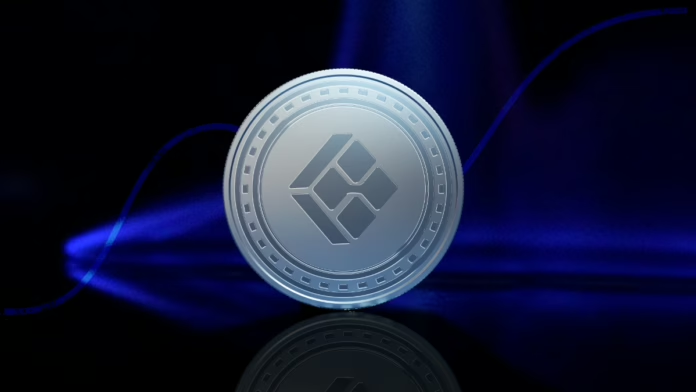
One such emerging token is LMGX, which is positioning itself within the growing ecosystem of tokenized assets.
The project focuses on improving accessibility, transaction efficiency, and integration with real-world financial instruments.
While still developing, LMGX reflects a broader trend in Web3: moving beyond speculation toward utility – driven tokens that support real economic activity.
Its progress highlights how newer entrants are attempting to solve existing limitations in tokenization, particularly around scalability and usability.
Conclusion
Real – world asset tokenization represents a fundamental shift in how value is created, managed, and exchanged. With institutional backing, growing infrastructure, and clear use cases, it stands out as one of the most promising sectors in Web3.
As adoption accelerates, tokenization may redefine global finance – turning traditionally inaccessible markets into open, efficient, and programmable ecosystems.